
Other virtual visits by Release Eletrônico
Beyond the projects with their own websites — Engenho São Jorge dos Erasmos and Porto em 360° — the História 360 channel features two more virtual visits produced by Release Eletrônico: the immersive re-creation of a painting, and a live-action portrait of one of São Paulo's most iconic neighborhoods.
Virtual Visit to the Painting Fundação de Santos, by Benedito Calixto
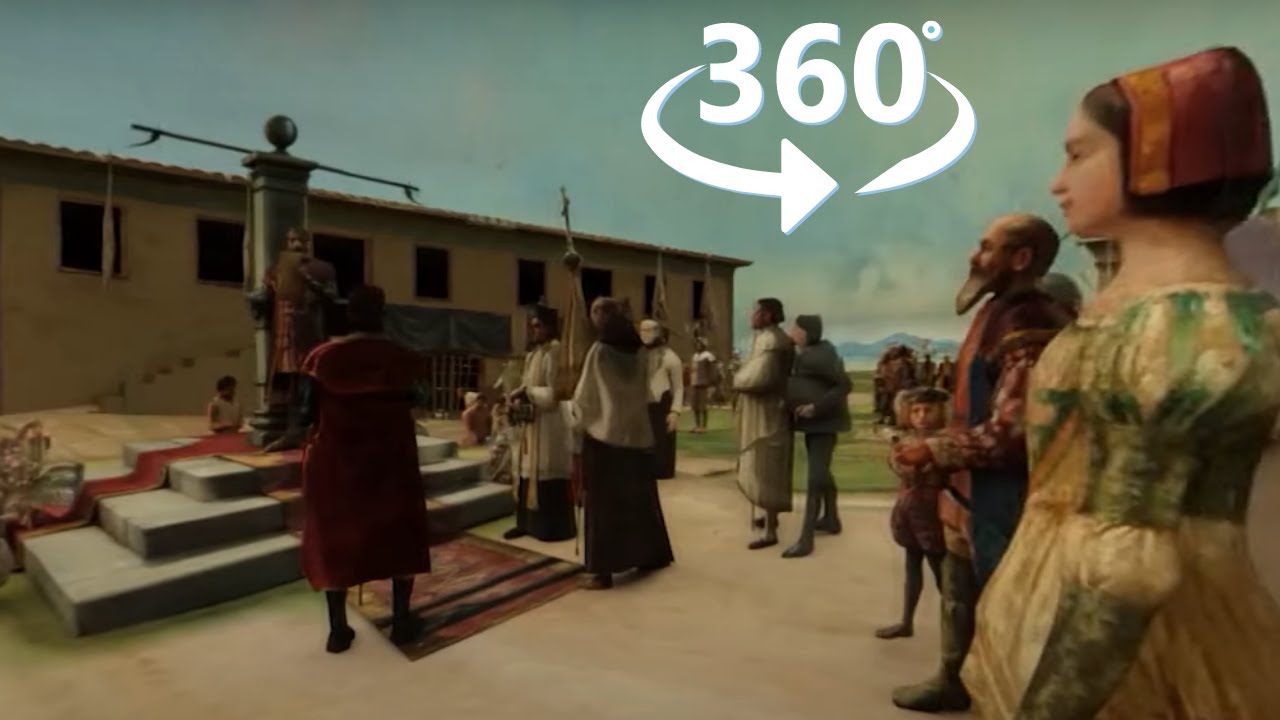
The painting Fundação de Santos, created by Benedito Calixto decades after the event it depicts, imagines the moment when Brás Cubas reads the Foral de Santos — the charter issued by the Portuguese Crown setting out how the city would be divided and organized, a sort of birth certificate for Santos. The original Foral has since disappeared — believed to have been destroyed in a fire in Portugal — so the production re-created the document based on the Foral de Olinda, a historical reference adopted by several Brazilian cities.
To give voice to Brás Cubas, the production brought in a native Portuguese narrator, based in Portugal and recorded with his original accent. The ambisonic audio soundtrack was created by sound engineer Flávio Medeiros, a longtime partner of Release Eletrônico.
The video opens with a walk through the Bolsa do Café in Santos — now a museum — before arriving at the 27 m² painting, where the narration invites viewers on a virtual visit: the painting expands to surround the entire scene, and the camera "enters" the artwork. Since this is a work of art, the people, objects and buildings remain static, just as in the original painting; only the camera moves, and the sound — absent from the painting itself — was entirely re-created based on extensive historical research into the setting, costumes and period.
The project was made possible with funding from PROAC and received the second-highest score in a creative economy grant process.
Virtual Visit to the Bixiga Museum

Unlike the Benedito Calixto painting, the Virtual Visit to the Bixiga Museum was filmed live action — real footage, with no re-creation. The Museu Memória do Bixiga (MUMBI), founded in 1981 by cultural activists Armando Puglisi and Paulo Santiago, preserves the living memory of one of São Paulo's most traditional neighborhoods — a territory shaped by a strong wave of Italian immigration, especially from Calabria, starting in the late 19th century, and which also holds deep Afro-Brazilian roots, present in its samba, terreiros and local cuisine.
Since Bixiga is considered an open-air museum — not just a single exhibition space, but an entire neighborhood of living memory — the production wasn't limited to MUMBI's collection. The crew also captured other central points of the region's cultural identity in immersive footage, such as the headquarters of Vai-Vai, one of São Paulo's most traditional samba schools, and the neighborhood's traditional theaters — such as Oficina and Sérgio Cardoso — which between the 1950s and 1980s turned the region into one of Brazil's leading theater hubs.
The result is an immersive portrait of São Paulo's multicultural identity, weaving together Italian immigration, Afro-Brazilian culture, samba and theater into a single 360° journey.